
A 10-minute practice path
- Sit upright, feet grounded, breathe naturally for 1 minute.
- Pick a comfortable shruti and let the tambura settle for 30 seconds.
- Sing Sa · Pa · Sa three times — focus on hitting Sa cleanly.
- Practice Adi Tala with claps for 3 minutes at 55 BPM.
- Cool down: hum the tonic Sa for 30 seconds.
Find your tonic
Tune the ear first. Pick a comfortable Sa and let it settle.
Sit with Sa
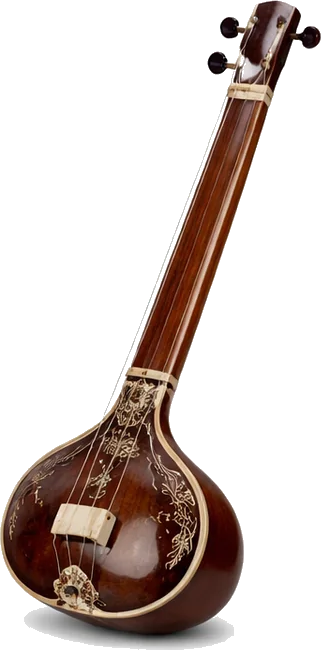
Choose your comfortable shruti before singing or flute practice.
These are tendencies, not rules. Your vocal texture and natural pitch matter more than gender — pick the shruti where Sa feels effortless in both octaves.
Hear and sing each note
From the basic Sa·Pa·Sa to all 16 sthanas.
Vocal warm-up
See swaras flow
Tip · All 16 swara sthanas in order. Notice how R3 & G1, G3 & M1, and D3 & N1sit at the same height — same pitch, different name depending on the raga. Hum each node on aaand let your voice trace the wave.
Every swara, on tap
Tap any column to hear it locked to your Sa, then match with your voice.
Tip · Start the tambura first, then tap each column and match the pitch with your voice on the vowel aa. Some swaras share a semitone but carry different names depending on the raga.
Hold the cycle steady
Sapta and chapu talas, spoken solkattu, and a plain metronome.
Clap, count, keep time
Live visualizer with mrudangam & jalra voices.
Recite the rhythm
ta · ka · di · mi — internalise tala before you play.
Speak the syllables aloud while the mridangam plays. The tongue learns the rhythm before the hands do.
Carnatic tala is built from three angas. Each has a fixed beat-count, a sign, and a hand action — paired with the mridangam phrasing below.
| Anga | Beats | Sign | Hand action | Mridangam phrasing |
|---|---|---|---|---|
| Anudrutam | 1 | U | Clap | Tha |
| Drutam | 2 | O | Clap → Wave | Tha (clap) → Di (wave) |
| Laghu (4-beat) | 4 | I₄ | Clap → little → ring → middle finger | Tha → Ka → Dhi → Mi |
A plain, continuous beat — independent of any tala. Set the tempo and let it run while you sing, recite, or play.